
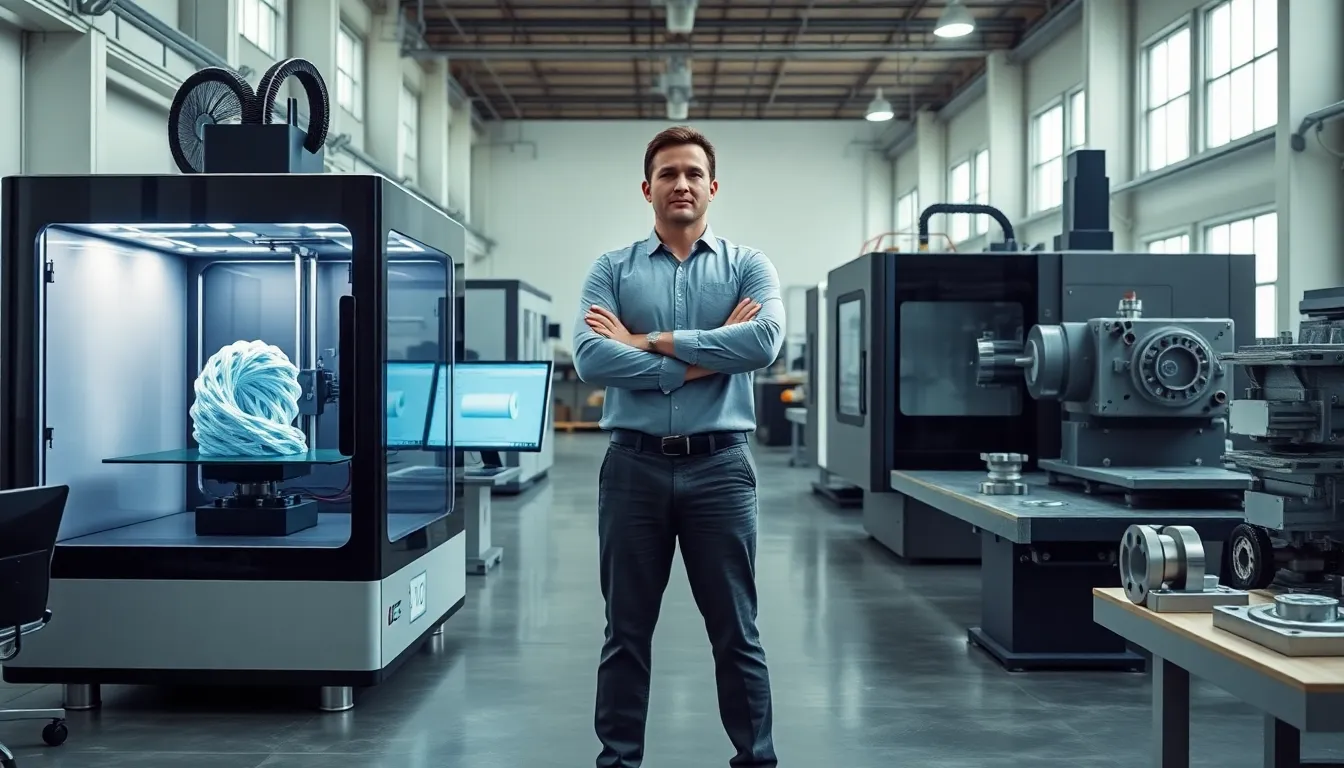
The debate of 3D printing vs traditional manufacturing has become a central question for businesses, engineers, and hobbyists alike. Each method offers distinct advantages depending on project requirements, budget constraints, and production volume. 3D printing builds objects layer by layer from digital files, while traditional manufacturing relies on processes like injection molding, CNC machining, and casting. Understanding these differences helps decision-makers select the right approach for their specific needs. This guide breaks down the key factors, from cost and speed to materials and ideal applications, so readers can make informed choices between 3D printing vs traditional methods.
Table of Contents
ToggleKey Takeaways
- 3D printing vs traditional manufacturing depends on production volume—3D printing excels for prototypes and low-volume runs, while traditional methods become cost-effective at scale.
- 3D printing adds material layer by layer with minimal waste, whereas traditional manufacturing often requires expensive molds or removes excess material.
- Traditional manufacturing typically breaks even between 100 and 10,000 units, after which per-unit costs drop significantly below 3D printing.
- 3D printing enables complex geometries, internal channels, and rapid design iterations that would be impossible or costly with conventional techniques.
- Material options and part strength generally favor traditional manufacturing, though advanced 3D printing technologies now serve aerospace and medical applications.
- Many businesses use a hybrid approach—3D printing for validation and early production, then transitioning to injection molding for mass manufacturing.
How 3D Printing Works Compared to Traditional Methods
3D printing, also called additive manufacturing, creates objects by depositing material layer by layer. A digital 3D model guides the printer, which extrudes plastic, resin, metal powder, or other materials into precise shapes. The process requires minimal tooling and can produce complex geometries that would be impossible with conventional techniques.
Traditional manufacturing takes a different approach. Methods like injection molding require custom molds, which machines fill with molten material. CNC machining cuts away material from a solid block to achieve the desired shape. Casting pours liquid metal or plastic into pre-made forms. Each traditional method demands significant upfront investment in tooling and setup.
The fundamental difference comes down to addition versus subtraction (or formation). 3D printing adds material only where needed, reducing waste. Traditional methods often remove excess material or require molds that take weeks to produce. This distinction drives many of the cost, speed, and flexibility differences between 3D printing vs traditional manufacturing approaches.
Another key contrast involves design freedom. 3D printing can produce internal channels, lattice structures, and organic shapes in a single print. Traditional manufacturing typically requires assembly of multiple parts to achieve similar complexity. Engineers working with 3D printing vs traditional processes often redesign components to take advantage of additive capabilities.
Cost and Speed Differences
Cost calculations for 3D printing vs traditional manufacturing depend heavily on production volume. For small batches or prototypes, 3D printing almost always wins. There’s no need to create expensive molds or tooling. A manufacturer can print one unit or fifty without significant per-unit cost changes.
Traditional manufacturing becomes cost-effective at scale. An injection mold might cost $10,000 to $100,000 to produce, but it can create millions of identical parts at pennies each. The break-even point varies by part complexity and material, but traditional methods typically become cheaper somewhere between 100 and 10,000 units.
Speed tells a similar story. 3D printing delivers prototypes within hours or days. Designers can iterate quickly, testing multiple versions in a single week. Traditional manufacturing requires weeks or months for tooling before the first production part emerges. But, once tooling exists, traditional methods produce parts much faster, injection molding can cycle every few seconds.
Consider this real-world example: A startup developing a new consumer product might use 3D printing for the first 500 units while validating market demand. If sales prove strong, they transition to injection molding for mass production. This hybrid approach leverages 3D printing vs traditional manufacturing strengths at each stage.
Labor costs also differ. 3D printing requires less manual intervention during production but may need more post-processing. Traditional manufacturing often involves skilled machine operators and quality control personnel throughout the process.
Material Options and Quality Considerations
Material selection represents a critical factor in choosing between 3D printing vs traditional manufacturing. Traditional methods work with virtually any material, metals, plastics, ceramics, glass, and composites. Decades of development have optimized these processes for specific material properties.
3D printing materials have expanded rapidly but still lag behind traditional options. Common 3D printing materials include:
- PLA and ABS plastics – Affordable and widely available
- Nylon – Durable with good flexibility
- Resins – High detail and smooth surface finish
- Metal powders – Steel, titanium, aluminum for industrial applications
- Carbon fiber composites – Lightweight with high strength
Quality differences matter for end-use parts. 3D printed objects often show visible layer lines and may have anisotropic properties, meaning strength varies depending on print orientation. Injection-molded parts have consistent properties throughout and smoother surfaces straight from the mold.
Part strength in 3D printing vs traditional manufacturing comparisons generally favors traditional methods. A CNC-machined aluminum bracket will outperform a 3D printed equivalent in most stress tests. That said, advanced 3D printing technologies like selective laser sintering (SLS) and direct metal laser sintering (DMLS) produce parts suitable for aerospace and medical applications.
Surface finish requirements influence the decision. Traditional manufacturing achieves mirror-smooth surfaces directly. 3D printed parts typically need sanding, coating, or other post-processing to match that quality. For functional prototypes where appearance doesn’t matter, 3D printing delivers acceptable results much faster.
Best Use Cases for Each Manufacturing Approach
Choosing between 3D printing vs traditional manufacturing comes down to matching the method to the project requirements. Each approach excels in specific situations.
3D printing works best for:
- Prototypes and proof-of-concept models
- Custom one-off parts (medical implants, dental aligners)
- Low-volume production runs under 1,000 units
- Complex geometries that can’t be machined or molded
- Rapid design iterations during product development
- Replacement parts for obsolete equipment
Traditional manufacturing suits:
- High-volume production (thousands to millions of units)
- Parts requiring specific material properties
- Applications demanding tight tolerances and consistency
- Products where per-unit cost drives profitability
- Components needing certified material specifications
The aerospace industry demonstrates how 3D printing vs traditional manufacturing can work together. Engineers use 3D printing to prototype new bracket designs, test them, and refine the geometry. Once validated, they may produce flight-critical versions using traditional CNC machining from certified aluminum or titanium stock.
Consumer electronics companies face similar decisions. Early prototypes come off 3D printers for fit checks and user testing. Production units ship from injection molding facilities capable of producing millions of identical enclosures.
Small businesses benefit most from understanding when each method applies. A jewelry designer might use 3D printing exclusively for custom pieces. A manufacturer of commodity hardware would never consider 3D printing for production volumes in the millions.


